Two platforms. One operating principle.
The Navia and Cybergo platforms are the core of Induct Technology's autonomous mobility catalogue. Both are fully electric, driverless, and designed for structured route operation in managed environments. Neither is a prototype. Both entered commercial deployment.
What these platforms are for
The central design logic of both Navia and Cybergo is operational simplicity within a defined geographic boundary. Neither platform attempts to navigate open urban traffic. Both are built around the insight that the most commercially viable path to autonomous passenger transport runs through environments where the complexity of the problem has already been reduced - campuses, airports, managed estates, business parks.
That narrowing is not a weakness. It is the design brief. When a shuttle operates on a fixed campus loop between five stops, the engineering challenge shifts from general-purpose perception and decision-making to reliability, passenger comfort, obstacle response within a known environment, and fleet coordination. Both Navia and Cybergo were built to address that specific challenge.
Navia
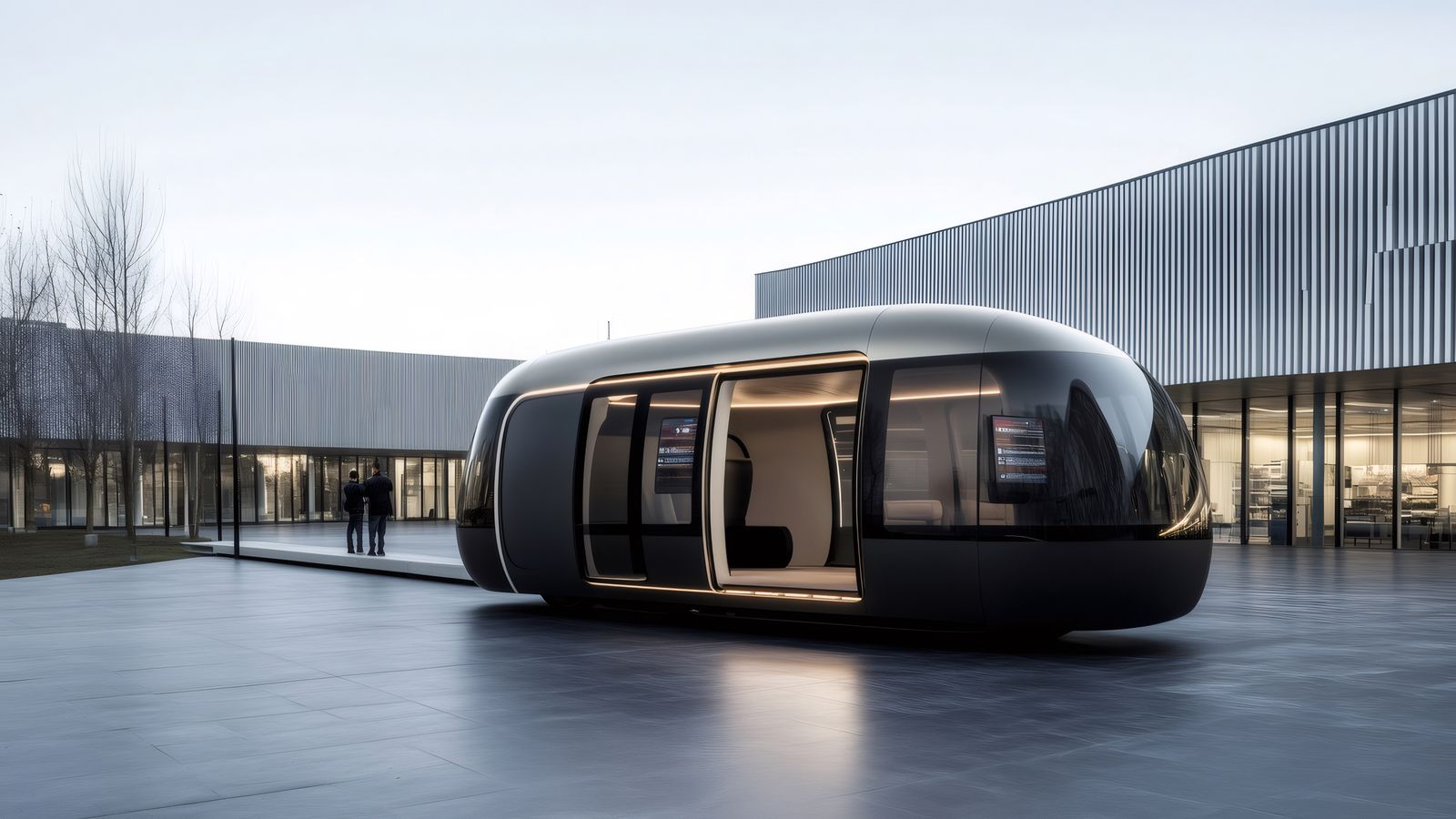
Navia is the primary platform in the Induct Technology product family. It is a compact, fully electric, driverless shuttle designed for pedestrian-scale environments - the kind of routes that connect buildings, terminals, or facilities across distances that are too long to walk comfortably but too short to justify conventional vehicle transport.
The vehicle carries a small number of passengers - typically between six and eight seated - at walking-adjacent speeds. It uses LiDAR, camera, and sensor fusion to navigate its operating environment and detect obstacles. Operation requires a defined map of the route, which is built during an initial installation phase before passenger service begins.
Navia was positioned as the first commercially available self-driving vehicle - a framing that required careful interpretation, given that "commercially available" meant available for deployment contracts in managed environments, not for sale as a general consumer product. That distinction matters and is covered in more detail on the dedicated Navia pages.
- Navia - product documentation
- Navia - the 100% electric automated transport
- Navia (en français)
- Navia - version 2 (en français)
- Navia: un concentré de technologie
Cybergo
Cybergo is the second platform in the product family, developed with a particular focus on the United States market. Its launch represented one of the early formal market entries for a commercially available driverless electric shuttle in North America - a significant moment in the wider development of autonomous transit.
Like Navia, Cybergo operates on fixed routes in managed environments. The platform was designed with a different exterior form factor and was positioned to address specific North American deployment requirements, including ADA accessibility considerations and the operational conventions of U.S. campus and facility management.
How to read these product pages
The product documentation on this site covers each platform's design context, operating characteristics, deployment environments, and the specific claims that were made at launch. Where claims require careful framing - particularly around what "world's first" or "commercially available" meant at the time - the pages address that directly rather than repeating marketing language without context.
The goal is documentation that remains useful as a record of where autonomous shuttle technology stood at specific points in its development, and what the practical deployment picture looked like beyond the press release framing.
Navia
Product documentation for the core Navia autonomous shuttle platform. Deployment contexts, operating characteristics, and design logic.
Read moreNavia: 100% Electric Automated Transport
Technical product page covering the electric drivetrain, automation systems, and what "100% automated" means in a structured-route context.
Read moreCybergo
Platform notes for the Cybergo driverless electric shuttle, developed for U.S. deployment and positioned as a commercially available autonomous transport solution.
Lire la suiteNavia (français)
Page produit Navia en français. Contexte de déploiement, caractéristiques opérationnelles et positionnement dans la famille de produits Induct.
Lire la suiteNavia 2 (français)
Documentation de la deuxième version de la plateforme Navia, couvrant les évolutions de la conception et les améliorations opérationnelles.
Lire la suiteNavia: un concentré de technologie
Page éditoriale explorant la densité technologique de la plateforme Navia - capteurs, systèmes embarqués, et intégration applicative.
Lire la suite